Leisure Centre Flooring guide
Leisure Centre Flooring for Changing Rooms, Showers and Pool Routes
A zone-led guide to mixed barefoot and shod traffic, pool water, toiletries, drainage, cleaning controls and phased leisure-facility work.
Direct answer
Leisure-centre flooring should be specified zone by zone, not selected from one universal rating. Assess barefoot and shod users, water, toiletries, pool-water and cleaning residues, drainage, transitions and access, then verify the complete floor system against the risk assessment and current manufacturer instructions. UK law requires suitable, safe workplace floors but does not prescribe one leisure product, R rating or PTV.
Leisure facilities in Herefordshire and Gloucestershire may combine dry reception routes, mixed changing circulation, showers and pool-adjacent areas within a short distance. A facility in Hereford or Gloucester should define each zone and its users before comparing products. Law sets the operator's duty to assess and manage risk; HSE and Sport England provide guidance; test methods supply evidence; and manufacturer declarations apply only to the stated system and conditions.
What does leisure-centre flooring need to achieve?
Changing areas, shower exits and routes near pools can receive water, shampoo, shower gel, pool water, dirt and cleaning residue. Users may be barefoot, wearing outdoor shoes or staff footwear, and may include children, older visitors and people using mobility aids. A floor alone cannot control behaviour, drainage, cleaning or every fall risk.
Apply the same needs-led process to a public leisure centre, hotel spa, school pool, therapy pool or private facility, while checking which duties apply to that setting. Avoid broad claims that any product is HSE, CQC or NHS approved.
How should changing rooms, showers and pool routes be zoned?
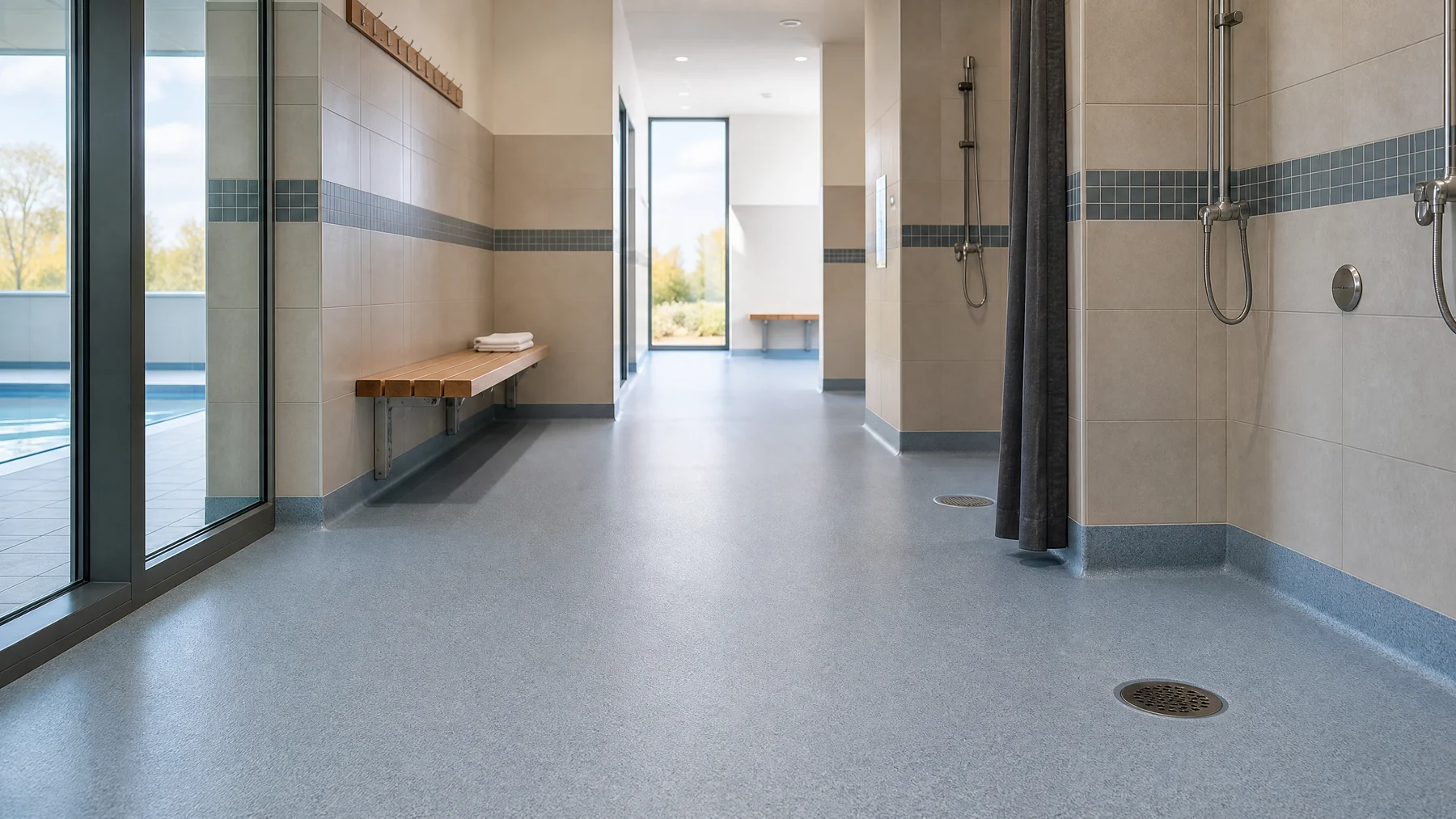
Draw boundaries from observed use rather than room names alone. The dry entrance may receive wet footwear; changing circulation may mix barefoot and shod users; showers face regular soap and water; and pool-adjacent routes combine humidity, pool water and varied directions of travel. Transitions can be a risk in their own right.
Sport England's pool design guidance recommends the highest grade of slip resistance in barefoot-only areas such as showers and pool surrounds and gives design advice on drainage and testing. It is sector design guidance, not legislation and not an endorsement of one product. The project still needs relevant evidence, cleaning and maintenance.
| Zone | Typical conditions | Questions for the specification |
|---|---|---|
| Dry arrival | Shoes, tracked water and grit | Can matting and housekeeping contain spread, and are transitions flush and visible? |
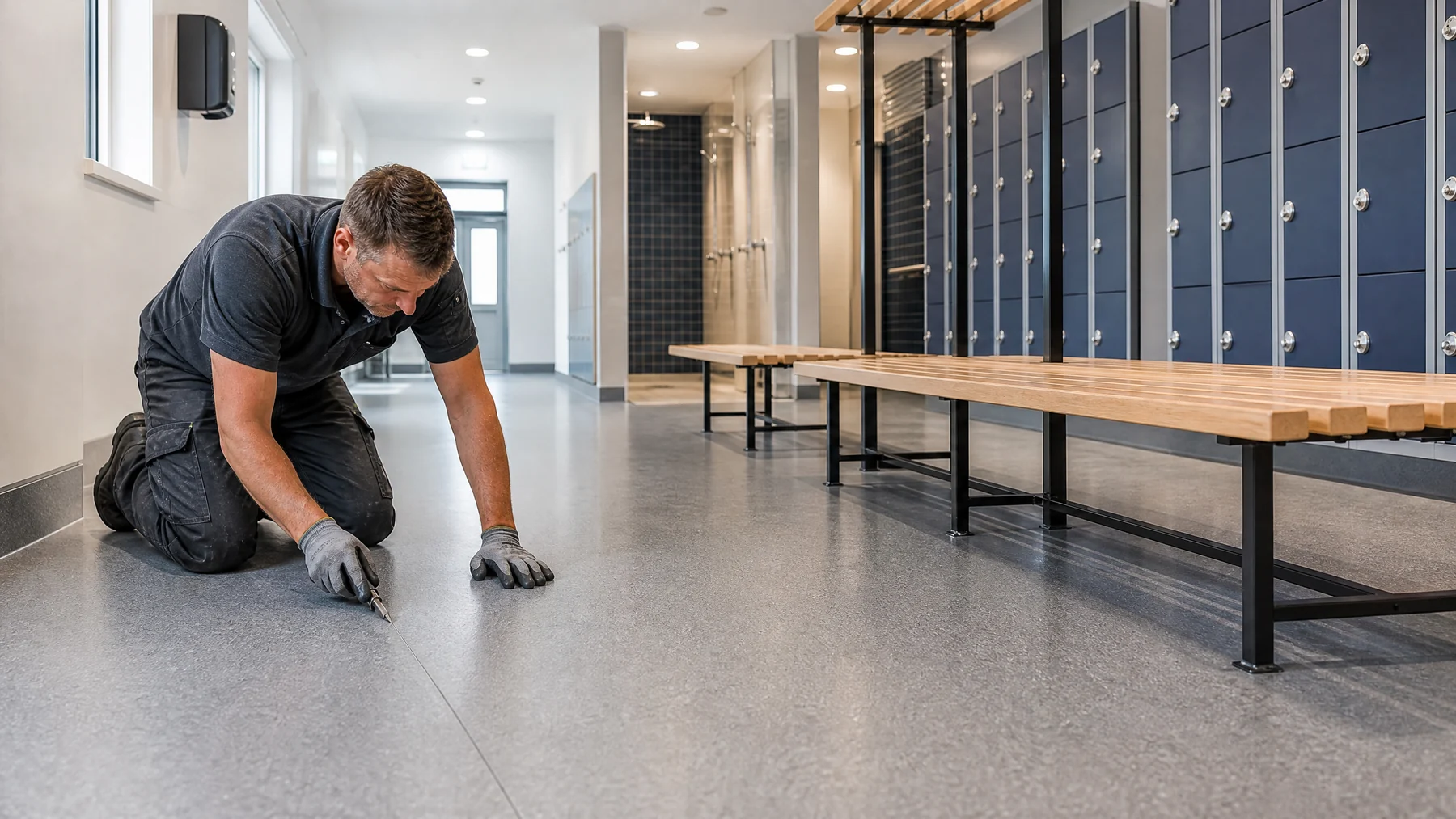
| Changing circulation | Mixed barefoot and shod users, drips, bags and benches | Does evidence match mixed use, and can the texture be cleaned effectively? |
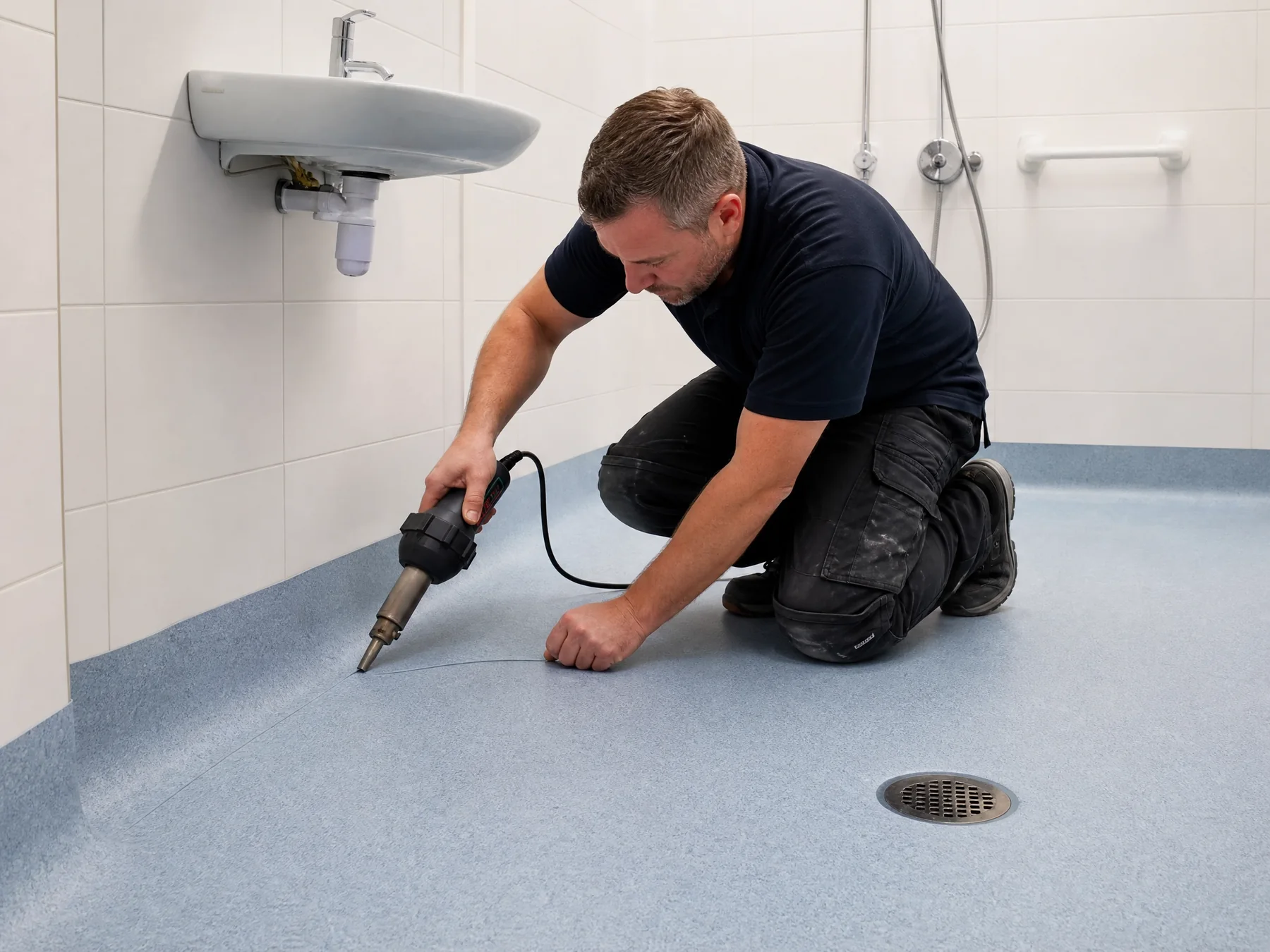
| Shower area | Regular water, soap, bare feet, staff footwear and drains | Are floor, falls, drains, seams and wall junctions a compatible system? |
| Pool-adjacent route | Pool water, humidity, wet bare feet and staff traffic | What contaminant, direction, edge detail, traffic and drainage apply? |
| Transition | Change from wet to dry, shoes to bare feet or one finish to another | Is the junction level, legible, cleanable and included in access planning? |
Is an R rating or PTV enough for a pool environment?
No. DIN 51097 is a barefoot ramp method using a soap solution, while DIN 51130 is a shod ramp method using motor oil and heavily cleated footwear. HSE warns that laboratory classifications can be misapplied when contaminant and footwear do not represent actual conditions. An R rating alone does not prove wet-barefoot suitability.
Sport England's 2013 pool-design guidance gives a minimum plus 36 pendulum value using appropriate test equipment and the likely pollutant. Attribute that to the guidance: it is not a statutory UK PTV threshold or an automatic rule for every zone. The client specification should state what evidence and any verification are required.
Sport England's plus 36 statement is pool-design guidance. It must not be described as a universal legal pass mark.
How do pool water, chemicals and drainage affect selection?
Slip data does not establish chemical compatibility. Pool water, humidity, cleaning chemicals, adhesives, welding rods, sealants, drains and the substrate should be considered as one system. Obtain current written manufacturer advice for expected exposures and retain product, batch and installation information in the operation and maintenance record.
Inspect falls, outlets, ponding, substrate and wall or pool-edge interfaces before selecting the method. Workplace law requires effective drainage where necessary; Sport England also gives pool-design advice on falls. Neither supports copying one generic gradient or drain detail into every resilient-floor installation.
How do cleaning and access controls protect performance?
The cleaning plan should reflect how quickly each contaminant returns and how the selected texture can be cleaned. Map zones, use manufacturer-approved chemicals and equipment, follow dilution and contact-time instructions, remove residue and inspect drains, seams, coves, edges and transitions. Review the process after a change in programming, footfall, chemicals, machinery or incidents.
Where a therapy-pool facility forms part of regulated care, CQC expects premises to be clean, suitable and maintained, with an appropriate cleaning schedule and monitoring. CQC regulates the provider; it does not approve the flooring product.
- Identify who owns routine cleaning, spot cleaning and defect escalation in every zone.
- Use current manufacturer instructions for chemicals, tools and removal or drying method.
- Keep users away from wet, unfinished or uncured areas using effective physical controls.
- Log damage, drainage issues and incidents so the risk assessment can be reviewed.
Can a leisure centre remain open during installation?
Some operations may continue if the client and project team agree a risk-assessed programme, but an unconditional promise is inappropriate. Coordinate pool sessions, school bookings, changing provision, accessible and emergency routes, deliveries, noise, dust, odour, ventilation, cure times, temporary barriers and final cleaning.
Before reopening, jointly inspect seams, drains, coves, transitions, cleaning compatibility and access. Hand over maintenance instructions and any specified test evidence. A phased plan can reduce disruption around sessions in Worcester or Shrewsbury, but it cannot guarantee zero disruption or a fixed closure duration before survey.
What affects cost, and when should flooring be renewed?
Cost depends on the number and shape of rooms, system choice, colours, substrate repair, moisture control, uplift, drainage, falls, wall junctions, welded seams, restricted access, phasing, temporary routes, out-of-hours work, testing and handover. An accurate quote follows a survey; a single national square-metre price omits the main project risks.
For changing rooms, showers and pool-adjacent routes across Herefordshire, Worcestershire, Shropshire and Gloucestershire, request a zone plan and written specification that explains interfaces, exclusions and operation during work. This gives managers a sounder procurement basis than choosing one product for an entire building.
Common questions
Frequently asked questions
01What flooring is best for leisure changing rooms and showers?
There is no single best product. Assess barefoot and shod users, water, soap, pool water, drainage, cleaning and access, then verify current manufacturer evidence for each zone and the complete installation system.
02Do leisure-centre changing rooms have to be R11?
No UK rule makes R11 universal for changing rooms. R values come from a shod ramp test and should not be used alone for mixed barefoot and shod wet areas. Assess the actual location and intended use.
03Is PTV 36 a legal requirement for a pool floor?
No. HSE describes 36 or above as low slip potential under test conditions, while Sport England gives plus 36 in its pool-design guidance. Neither creates a blanket statutory threshold; test details and risk remain important.
04Can standard vinyl be used beside a swimming pool?
Do not assume so. The manufacturer evidence must cover the specific zone, including expected wet barefoot or shod traffic, contaminants, cleaning, drainage and system interfaces. A dry-corridor product is not automatically suitable.
05Does chlorine damage safety flooring?
Compatibility depends on the complete system and exposure. Obtain current written advice for pool water, chemicals, adhesive, welds and sealants, and manage staff chemical exposure through COSHH controls.
06Can a leisure centre stay open while flooring is replaced?
Possibly in unaffected areas, under an agreed phased plan that protects emergency and accessible routes, isolates work, observes cure times and keeps users away from unfinished or wet surfaces until handover.
07Is leisure flooring HSE, CQC or NHS approved?
Do not rely on those labels. HSE gives safety guidance and CQC regulates care providers; neither provides a general product approval. Use the site risk assessment, client specification and current manufacturer instructions.
Evidence base
Sources and further guidance
Requirements and product data can change. Confirm current legislation, regulator guidance, manufacturer instructions and the project specification before making a final decision.
- 1Workplace Regulations 1992, regulation 12
- 2HSE: Swimming pool safety management
- 3HSE: Flooring and contamination
- 4HSE: Assessing the slip resistance of flooring
- 5Sport England: Swimming pools design guidance, Appendix 3
- 6Sport England: Accessible and inclusive sports facilities
- 7HSE: The importance of floor cleaning
- 8HSE: COSHH and cleaning chemicals
Local specialist support
Project-specific flooring advice
Safety Flooring Specialist Ltd serves Herefordshire, Worcestershire, Shropshire and Gloucestershire. For a site survey in Hereford, Worcester, Shrewsbury, Gloucester or the surrounding areas, call 01432 381759.
Related guidance